If you've spent any time on LinkedIn, YouTube, or Reddit recently, you've probably stumbled across some version of this headline: "AI Has Killed Web Development." It's alarming. It's clickable. And it is, in large part, completely wrong.
The truth is far more interesting — and far more nuanced. Web development isn't dying. It's undergoing the most significant transformation it has seen in two decades. And the developers who understand what's actually happening are positioning themselves for the best career opportunities in the field's history.
Let's separate the fear from the facts.
The "web dev is dead" story didn't come from economists, labor statisticians, or hiring managers. It came from viral LinkedIn posts, YouTube thumbnails, and content creators who discovered that fear generates clicks far more effectively than nuance does.
Meanwhile, the actual data tells a completely different story. Consider these figures from 2026:
These are not the numbers of a dying industry. They are the numbers of an industry in the middle of a major evolution — one that is creating more high-value opportunities, not fewer.
Here's a pattern worth noticing: every few years, someone declares web development dead.
First it was Dreamweaver. Then WordPress. Then no-code platforms. Now it's AI. Each time, the tools got smarter — and the people who knew what they were doing produced better products.
When WordPress arrived, pundits claimed it would make developers obsolete. Instead, it created an entire ecosystem of developers building themes, plugins, and custom integrations. When no-code platforms like Wix and Squarespace emerged, the same panic followed. Instead, it freed developers from building basic brochure sites so they could focus on complex, high-value work.
AI is following the exact same pattern. The tools are getting more powerful. The developers who adapt are getting more valuable. And the ones clinging to the old, narrow definition of "writing code" are the ones who should be worried.
Let's be honest about what AI is genuinely good at in web development. It's remarkable — and worth acknowledging without defensiveness.
AI tools like GitHub Copilot, ChatGPT, and Claude can handle:
AI has genuinely automated the "boring parts" of web development. And the honest developers among us are grateful. Spending eight hours debugging a CSS flex box issue or writing repetitive CRUD controllers was never the point. The point was always solving the problem.
But here's where the "AI will replace developers" argument falls apart. Code is not the product. The product is a working digital experience that serves real business goals, real users, and real-world conditions.
Ask yourself: can AI do any of the following?
AI won't call you back with a fix. None of that is automatable yet. And none of it is likely to be automatable soon.
The honest framing is this: AI has raised the baseline expectation of what websites should do. Businesses that previously settled for a static five-page site now expect real-time personalisation, seamless third-party integrations, sub-second load times, and AI-native features. The bar has moved up, not down.
Here is a statistic that doesn't get nearly enough attention in the "AI will replace developers" conversation: 40% of AI-generated code contains at least one critical security vulnerability.
This isn't a minor footnote. It's a fundamental limitation. AI tools generate code based on patterns from training data — they don't truly understand the security context of the specific application they're writing code for. They can't know that a particular endpoint handles sensitive financial data, or that a given input sanitisation approach is insufficient for a healthcare application handling PHI.
As cyber threats have escalated — with a 67% surge in attacks in recent years — businesses need developers who can audit AI-generated code, identify these vulnerabilities, and build hardened infrastructure. If anything, the rise of AI-generated code has made security-conscious developers more valuable, not less.
The U.S. Bureau of Labor Statistics is not a content creator with a YouTube channel to monetise. Its projections are based on actual labor market analysis. And those projections show web developer employment growing between 7% and 16% through 2032 — depending on specialisation.
To put that in context: the average growth rate for all occupations is roughly 5%. Web development is growing at nearly triple that rate. This is not the trajectory of a dying field.
The nuance worth noting: not all web development roles are growing equally. Junior roles focused on simple tasks are the most vulnerable to automation. Senior, full-stack, and specialised roles — security engineers, AI integration specialists, cloud architects — are in higher demand than ever.
The global website development services market reached $87.75 billion in 2026. It is projected to grow at a compound annual growth rate of 6.29%, reaching a market volume of $4.96 trillion by 2030 when adjacent software and digital infrastructure markets are included.
This growth is being driven by several forces:
If AI were genuinely replacing web developers, you'd expect to see it in hiring data. You don't. In 2026, 55% of companies report plans to grow their development teams. This counterintuitive statistic makes complete sense when you understand what's driving it.
As AI lowers the barrier for simple websites, it simultaneously increases the complexity — and the necessity — of high-end, custom-engineered platforms. Companies that previously outsourced a basic WordPress site now want AI-native applications with personalised user experiences, real-time data integrations, and enterprise-grade security. Building those requires more developer expertise, not less.
The most important mindset shift for any developer navigating this moment is this: the value of web development was never in typing code. It was always in solving problems.
Typing code was just the mechanism — the means of translating a business need into a functional digital product. If AI can now handle more of the typing, that doesn't diminish the value of the developer. It amplifies it. The developer is freed from the mechanism and can focus entirely on the problem.
Web development is leaving behind a world where developers memorise syntax, and entering a world where developers are high-level solution architects.
This is the shift from code typist to digital strategist. The developers who thrive will be the ones who can think about systems, understand business context, make architectural decisions, and use AI tools to execute with greater speed and precision than was ever possible before.
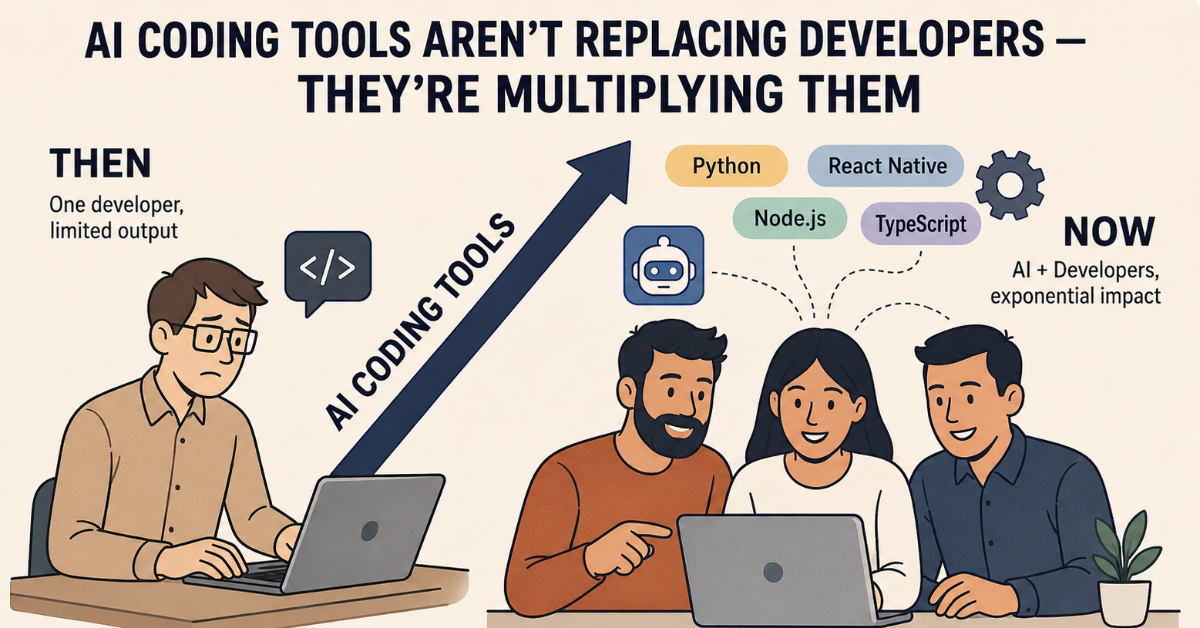
The most useful frame for AI in web development isn't "replacement" — it's "sidekick." The developers who are winning right now are the ones who have embraced AI as a powerful pair programmer and productivity multiplier.
GitHub Copilot doesn't replace the developer — it removes the grunt work. It handles the boilerplate so the developer can focus on the architecture. It writes the unit tests so the developer can focus on designing the logic. It generates the first draft of documentation so the developer can refine and contextualise.
Think of it the way a calculator relates to an accountant: it can improve speed and efficiency, but it doesn't make the professional redundant. The judgment, the strategy, the client relationship — those remain human.
AI is your dev sidekick. Not your replacement.
One of the clearest structural changes in web development hiring in 2026 is the shift away from narrow specialization toward full-stack and "T-shaped" engineers — developers with broad capability across the stack and deep expertise in one or two areas.
This shift is being accelerated by AI. When AI can handle a significant portion of routine frontend and backend tasks, teams don't need five narrow specialists to cover five narrow areas. They need two or three developers who can contribute across the stack, make system-level decisions, and use AI tools to fill gaps efficiently.
For developers, this is both a challenge and an opportunity. The challenge is that you need to know more. The opportunity is that knowing more makes you dramatically more valuable than a narrow specialist whose specific niche is being automated.
Let's be direct about what is actually declining in web development. If your value proposition as a developer is "I can build you a basic website," you are in a race to the bottom — and AI has just lapped you.
Basic HTML/CSS freelancing — the kind that produces simple brochure sites, landing pages, or portfolio sites without meaningful technical complexity — is genuinely threatened. Not because the demand for simple websites has gone away, but because the supply of tools that can produce them without a developer has become abundant and affordable.
Wix, Webflow, Squarespace, and dozens of AI-powered website builders can now produce functional, reasonably attractive simple sites in minutes. If that's the core of your offering, it's time to move up the value chain.
Manual QA testing — clicking through features one by one, writing repetitive test cases by hand, checking browser compatibility manually — is another area experiencing genuine automation-driven disruption. AI-driven automated testing has become the standard for quality assurance at serious development shops.
This doesn't mean QA is dying. It means the nature of QA work is changing. The valuable QA skill in 2026 is designing test architectures, interpreting automated test results, identifying edge cases that automated tests miss, and ensuring that AI-generated tests are actually testing the right things. The manual clicking is going away. The judgment is staying.
Perhaps the most significant casualty of AI in web development is the "copy-paste developer" — the junior dev whose primary skill was finding Stack Overflow answers and assembling them into vaguely working solutions without truly understanding the underlying systems.
AI can do that better than any human. It can find the relevant code pattern, adapt it to the specific context, and implement it faster than any developer could copy and paste. If that was your primary competitive advantage, you need to develop new ones — and quickly.
The good news: copy-paste coding was always a ceiling, not a floor. Developers who understood the "why" behind the code were always more valuable. AI has simply made that more visible and more urgent.
No-code and low-code platforms represent a genuine and significant market force. Gartner has predicted that low-code development tools will account for 75% of new application development by 2026, and the global low-code market is projected to reach $86.9 billion by 2027. These numbers deserve to be taken seriously.
But here's what those numbers don't tell you: "new application development" includes an enormous number of very simple applications. Internal dashboards, basic landing pages, simple intake forms, prototype MVPs — these are legitimate use cases for no-code tools, and no-code is genuinely the right answer for them.
For everything else — complex business logic, custom integrations, performance optimisation, enterprise security, scalability beyond a few thousand users — no-code platforms consistently hit hard walls. Their customisation and scalability limitations are not incidental flaws. They are inherent to the template-based architecture that makes them accessible in the first place.
The clients who come to serious development agencies in 2026 are not coming because they couldn't find a no-code tool. They're coming because the no-code tool failed them — because they hit a customisation limit, a performance issue, an integration that the platform couldn't support, or a security requirement that the shared infrastructure couldn't meet.
Enterprise e-commerce platforms processing thousands of transactions per hour need custom performance optimisation that no drag-and-drop builder can provide. Healthcare applications handling protected health information need security architectures that shared-infrastructure tools fundamentally cannot guarantee. Financial platforms need regulatory compliance built into the codebase at every level.
These are not niche requirements. As businesses grow and their digital infrastructure becomes more critical, the limitations of no-code become more costly — and the need for custom developers becomes more acute, not less.
The Gartner 75% prediction is frequently cited as evidence that professional developers are becoming obsolete. Reading it more carefully reveals something different.
75% of new applications using low-code tools is not the same as 75% of development work being done by non-developers. Many of those low-code applications are being built by developers who are using low-code as an accelerator — just as they use frameworks, libraries, and AI assistants as accelerators. The line between "low-code" and "assisted development" is blurring, not the line between "developer" and "non-developer."
The more meaningful shift is that developers are increasingly being asked to work at a higher level of abstraction. This is not a threat to the profession. It's an upgrade.
The frontend ecosystem in 2026 is dominated by meta-frameworks: Next.js, Nuxt, Remix, and similar tools built on top of React and Vue. These frameworks handle routing, server-side rendering, data loading, and performance optimisation out of the box — and they are the baseline expectation for professional frontend development.
Knowing vanilla React or basic component patterns is no longer sufficient for most roles. The developers who are thriving are those who understand not just how to use these frameworks, but when and why to use specific rendering strategies, how to optimize for Core Web Vitals, and how to integrate with modern backend and data architectures.
The technical floor has risen. Meeting it is not optional if you want to remain employable.
Cloud architecture (AWS, Azure, Google Cloud) and security fundamentals have moved from "nice to have" to "essential" for serious web developers. As more development work involves deploying, scaling, and securing cloud-native applications, developers who understand only local development environments are at a significant disadvantage.
On the security side, the combination of more sophisticated cyber threats and the security vulnerabilities inherent in AI-generated code has created urgent demand for developers with genuine security knowledge. Understanding authentication, authorisation, input validation, SQL injection prevention, XSS protection, and secure API design is no longer the exclusive domain of security specialists. It's table stakes for any developer working on production systems.
One of the fastest-growing categories of web development work in 2026 is AI integration — building LLMs, AI assistants, recommendation engines, and machine learning features into web applications. Every modern business wants to integrate AI capabilities into its digital products. Very few companies have the internal expertise to do it.
Developers who understand how to integrate AI APIs, design AI-native user experiences, handle streaming responses, manage context windows, implement RAG (retrieval-augmented generation) architectures, and build responsible AI features are in exceptional demand. This is not a niche specialisation. It is rapidly becoming a core competency.
Perhaps the most underrated skill for future-proofing a web development career is also the least technical: developing genuine product sense and business thinking.
Clients and employers don't ultimately care about your proficiency with a specific framework. They care about outcomes — more sales, more sign-ups, more retention, lower churn, faster time to market. The developers who can speak that language, who can connect their technical decisions to business outcomes, who can sit in a strategy meeting and contribute meaningfully beyond the technical details — those developers are not replaceable by AI.
This means learning to read analytics, understanding conversion optimisation, thinking about user psychology, and treating every project as a product problem, not just an engineering problem.
Yes — but with clear eyes about what you're signing up for.
The easy entry-level path is narrowing. If your plan is to follow a few tutorials, copy projects from YouTube, and walk into a junior developer role, 2026 will feel tough. That path was already competitive before AI. AI has made it significantly harder.
But the long-term opportunity remains excellent for developers who are willing to go deeper. Build real projects that solve real problems. Develop a strong understanding of how systems work, not just how to write syntax. Learn to use AI tools as productivity multipliers, not crutches. Focus on full-stack skills and don't stay narrow.
The developers entering the industry in 2026 who do the work will find a market that values and compensates their skills better than ever. The ones looking for shortcuts will find AI has taken those shortcuts from them.
Mid-level developers — those with two to five years of experience and solid fundamentals — are actually in the best position to benefit from the current shift. They have the foundation to understand what AI tools are doing and where they go wrong. They have enough experience to develop the product sense and architectural thinking that AI can't replicate.
The upskilling path for mid-level devs isn't about starting over. It's about expanding upward: into system design, cloud architecture, security, AI integration, and business thinking. These are adjacent to what you already know. They build on your foundation rather than replacing it.
The one trap to avoid: staying comfortable with what you already know. The developers who will struggle are the ones who use AI as a reason to stop learning. The ones who will thrive are the ones who use AI to learn faster.
The most powerful career position in 2026's web development market is at the intersection of deep technical web development skills and genuine AI fluency. This combination is rare, valuable, and becoming more so.
"AI fluency" in this context doesn't mean being able to write prompts for ChatGPT. It means understanding how AI models work at a sufficient level to make good decisions about when and how to use them. It means knowing the limitations of AI-generated code and being able to audit and improve it. It means being able to design user experiences around AI features in a way that's genuinely useful rather than gimmicky.
Students who master both web development fundamentals and AI-assisted workflows have a measurable competitive advantage in the job market. This combination is, right now, the clearest path to being both employable and highly compensated.
Web development in 2026 is not dying. It is undergoing a fundamental transformation — one that is separating the developers who understand what their work is actually for from those who were only ever executing the mechanical parts.
The mechanical parts — syntax recall, boilerplate code, repetitive testing, basic layouts — those are going to AI. Quickly. And good riddance. They were never the point.
The actual point of web development — understanding what people need, designing systems that deliver it reliably and securely, making judgment calls that no amount of training data can automate, taking accountability when something goes wrong — that work is more needed and more valued than it has ever been.
Web development isn't dying. It's growing up. The developers who grow with it will find themselves doing the most meaningful, well-compensated work the field has ever offered. The ones who don't will find AI has, indeed, replaced them — not because AI became smarter than developers, but because they stopped growing.
The bar has risen. The opportunity has risen with it. The question is whether you're ready to meet it.




We create smart and reliable digital solutions for businesses of all sizes. Our focus is on quality design, strong performance, and strategies that help your brand grow online. Transform your vision into a fully functioning and highly responsive website with our expert website development services. Our skilled developers utilize the latest technologies to build custom... Introducing the revolutionary travel package management module. Craft dynamic itineraries, tailor pricing, track availability, manage inclusions, automate promotions, analyze trends. Optimize,... Social media marketing: We develop and execute a targeted social media strategy to increase your brand's visibility and engagement on popular social media platforms like Facebook, Instagram, and...
Services

Website Development

Tours & Travels

Social Media Marketing
Site Studio is amazing to work with! They are professional, responsive, and delivered a high-quality website that exceeded my expectations. I would highly recommend them to anyone looking for a website development service.
What our clients say about Site Studio
Satisfied people feedback

